Monitoring, predictive models and energy analytics for your building portfolio.
Bemsia integrates the building control system, official consumption and weather data into a single platform, applies machine-learning models per room and per item of equipment, and turns the result into operational diagnostics, recommendations, reports and demand flexibility.
From building data to decisions with a cost attached
Visibility of the portfolio
Electrical demand, setpoints, temperatures, run states and faults for every building and every item of equipment, alongside official consumption and outdoor conditions, on a single reference base.
Anticipation instead of reaction
The models estimate the expected behaviour of each room and each machine and flag any significant deviation: pre-conditioning started earlier than required, setpoint not reached at opening time, performance degradation.
Justified decisions
Every finding states the evidence used, the period analysed, the estimated annual cost and the recommended action, so that any measure can be defended before the property owner.
A family of models developed together with our clients
Bemsia maintains several families of predictive models, developed and validated with the buildings of the clients who use the platform. Each building is fitted with its own data; nothing is shared between clients and no model acts on the installation on its own.
Models per room, per equipment and per building
Thermal models describe how each room responds to outdoor conditions, internal gains and the operation of its terminal units. Performance models follow each item of equipment against its own reference. Consumption models explain the building's demand from weather, occupancy schedule and the operation of its systems.
- Optimal start and stop
- Deviation and degradation detection
- Measurement and verification of savings
- Continuous validation
- Competing algorithms
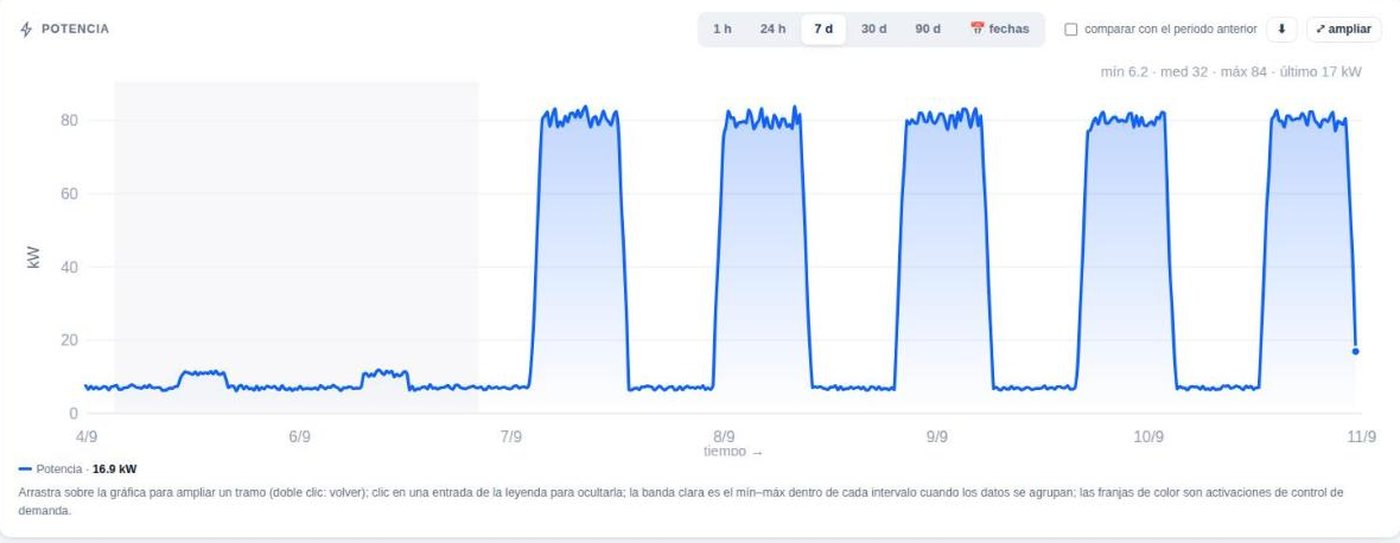
Recommendations and supervised actuation
The models produce operational recommendations with the evidence behind them: start-up times per room, schedules adjusted to actual occupancy, equipment requiring inspection. Each recommendation is reviewed by a person; once approved, it is executed through the same control path as any other write, with mandatory expiry, verification of reversion and a complete record.
- Deterministic analysis and models, clearly separated
- Traceable recommendations
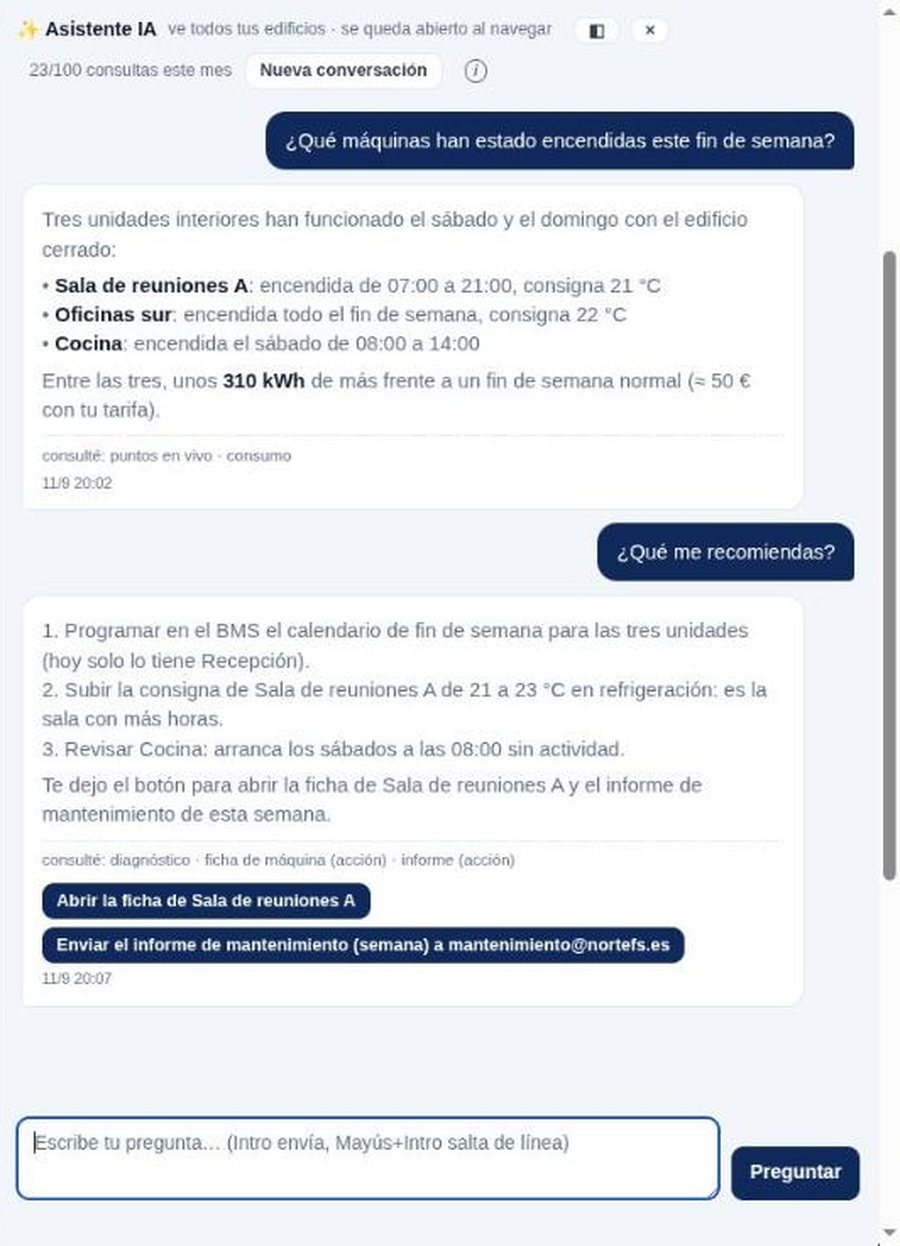
AI assistant
A natural-language interface to the platform data: consumption, BMS readings, inventory, diagnostics and reports for one building or the whole portfolio. Every answer cites the source of each figure and the assistant never writes to the installation.
Document and invoice processing
Equipment schedules, technical documentation and energy invoices are processed automatically to populate the inventory and the tariff, always subject to review before being applied.
Governed use of AI
Scope, monthly limits and cost per client are defined by the operator, with a full record of every invocation. Models never receive direct access to the database.
Monitoring, diagnostics, maintenance and reporting on a single data base
A connector deployed inside the building network reads the control system and forwards the measurements to the platform over an outbound encrypted connection. No inbound port is opened and no building protocol leaves the local network.
Diagnostics against actual occupancy
The occupancy schedule of each building is the reference: pre-conditioning so that rooms reach setpoint at opening time is expected operation, while starting earlier than required, failing to reach setpoint or operating outside occupancy is reported. Each finding documents the evidence, the data used, the estimated annual cost and the recommended action.
- By building, floor, room and equipment
- Client-defined checks
- Maintenance

Structured technical inventory
Each item of equipment is located in its floor and room, linked to the spaces it serves and grouped into installations by type: HVAC, ventilation, domestic hot water, lighting, photovoltaics, storage and electric vehicle charging. Control points are matched to equipment automatically from their address in the control system, and every point carries a standard role.
- Groupings defined by the client
- Control class to ISO 52120-1
Reporting and alerting
Periodic reports for the property in PDF, under the operator's own brand, with the sections each client requires, plus configurable alerting per client and per rule to email, Slack, Teams or webhook.
Improvement projects
Evaluation of measures before investment: setpoint and schedule changes, equipment replacement, photovoltaic generation or control upgrades, with investment, payback and subsequent verification of the saving achieved.
Energy benchmarking
Energy intensity per square metre against published references by building use, and comparison across the portfolio to prioritise where to act first.
Three ways to read a building, and one to start without installing anything
Each building comes in through the route its installation allows; routes can be combined in the same building and all of them feed the same models, diagnostics and reports.
The chosen route changes nothing else: inventory, diagnostics, models and reports are the same for all of them.
Four stages, starting in read-only mode
Bemsia connects to the systems the building already has
The platform is designed to integrate with any installed control system, with manufacturer cloud services and with the public data sources of the Spanish electricity sector. New integrations are added as adapters, without modifying the platform.
Building management systems
Open protocols (BACnet/IP, Modbus TCP) over the local connector, and manufacturer APIs where the control system exposes one. Compatible with the main vendors on the market.
Manufacturer cloud services
Direct connection to manufacturers' cloud platforms for installations without a local control system, complementing or replacing the connector.
Official consumption data
Hourly supply curves from the distributors' platform by supply point, for the whole portfolio, reconciled with the metering installed in the building.
Weather and market
Observed weather and seven-day forecast per location, and electricity market prices, used by the models and by the economic assessment of every measure.
Building registries
Cadastral data, surface areas and construction period, and the official energy performance certificate registries, as the basis for the envelope characterisation.
Documentation and invoicing
Equipment schedules, historical series and energy invoices in the usual formats, imported with review before being applied.
If your portfolio runs a system that is not yet supported, it is incorporated as a new adapter as part of the deployment.
Ready for the Active Demand Response Service and independent aggregation
Spain is opening the electricity markets to consumers' flexibility. Red Eléctrica's Active Demand Response Service (SRAD) pays consumers who reduce their demand when the system operator activates it; since 2026 it is auctioned twice a year and aggregated consumers can take part. Royal Decree 88/2026 regulates the independent aggregator, which combines many consumers to offer that flexibility in the balancing markets.
A building can only offer the flexibility it is able to measure and control safely. Bemsia provides that technical basis: connection to the control system, reduction capacity estimated per building with a conservative criterion, activations with mandatory expiry and verified reversion, auditable evidence for the market participant, and a shadow mode to validate the estimate before any actuation takes place.
- Active Demand Response Service (SRAD)
- Red Eléctrica's balancing service that pays for demand reduction capacity; semi-annual auctions since 2026.
- Independent aggregator
- Figure regulated by Royal Decree 88/2026 that groups consumers, generation or storage to take part in the electricity markets.
- Demand flexibility / demand response
- Reducing or shifting consumption for a period without losing the service, in exchange for remuneration (Directive (EU) 2019/944).
- Promisable capacity
- The kW a building can reduce right now with a conservative estimate: lower bound of the confidence interval, capped by what history supports.
The platform in use
Screens captured on a demonstration building.
Designed with the people who already look after the BMS
Maintenance companies and building managers
Organisations that already operate the control system and need an analytical layer above it: what happens in each building and each item of equipment, expressed in energy and cost, and which action to prioritise.
- Access scoped per user and per building
- Own catalogue of equipment models
- Reports for the property under your own brand
Operators and service providers
Portfolio management across multiple clients under a single brand, with roles for the operator's team and for each client's team, and capabilities enabled per client. Model results derived from the operator's own portfolio, with no data shared between clients.
- View and dashboard templates, reusable across clients
- Connector installer under the operator's brand
- Governed AI usage per client
A base subscription per client and the capabilities each portfolio requires
Each deployment is sized by number of buildings and capabilities enabled. Prices are quoted per proposal.
Platform
- Connection to the control system and integrations
- Continuous monitoring and full history
- Technical inventory, schedule and calendar
- Diagnostics and maintenance by rules
Predictive models
- Optimal start and stop with forecast
- Deviation and performance degradation
- Verified savings and anomaly detection
- Recommendations subject to approval
AI assistant
- Queries on one building or the whole portfolio
- Full building analysis
- Fault pre-analysis and document processing
- Usage governed per client
Operator
- Clients, buildings, team and roles
- Model results across the portfolio
- Own brand, templates and installers
- Capabilities enabled per client
Additional capabilities per client: reporting and alerting, improvement projects with measure evaluation across the portfolio, and demand flexibility.
The rules come before the features
Control is the risky part of any energy platform. This is how Bemsia handles it, in every building, from the first day.
- The connector always starts the connection: no inbound port is opened in the building's network and no building protocol crosses the internet.
- Every write carries a maximum duration and expires on its own, even if the cloud disappears.
- After every action the platform checks that each point returned to its previous value. If one did not, it raises an alarm.
- Neither the model nor the assistant acts on its own: proposals are approved by a person, and approval does not skip expiry or verification.
- Maintenance can exclude a building at any moment, and that exclusion is always respected.
- Every command is logged and visible to the client: what was written, when, on which point, and when it was released.
- Data is separated per client from the first table; no query can mix two clients.
Frequent questions
What does the AI model learn, and from what?
How each machine and each room of the building responds to the outdoor weather and to occupancy. It uses the BMS data every 15 minutes, observed weather, the 7-day forecast and the official Datadis consumption. It improves as it gathers data; while it learns, the rule-based diagnosis keeps working.
Can the AI assistant change anything in the building?
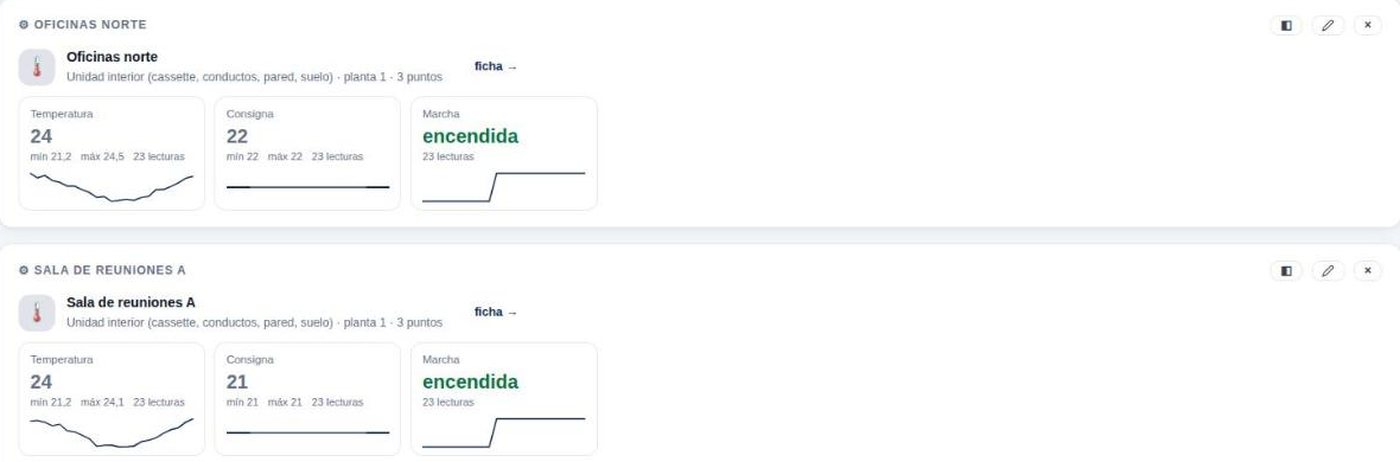
No. It answers with the platform's real data and cites where each figure comes from. It can prepare a machine card, a report or a chart for you, but it never acts on the building on its own.
Which BMS brands does it work with?
With any system that speaks BACnet/IP or Modbus TCP: BMS from the main vendors (Siemens, Schneider, Honeywell, Johnson Controls, Trend), Niagara platforms and the centralised controllers of the main HVAC manufacturers, as well as their cloud services. One driver per protocol; what changes is the point mapping.
Does Bemsia write on the building's control system?
Only if the client enables it, and always with automatic expiry, verification of reversion and a record of every command. By default it only reads.
What is the SRAD and who can take part?
The Active Demand Response Service of Red Eléctrica pays for demand reduction capacity. Since 2026 it is auctioned every six months and, through an aggregator, smaller consumers can take part. Bemsia gives the aggregator the measured capacity, the activation and the evidence per building.
Where is the data hosted?
On servers in the European Union, separated per client at database level. Building protocols never leave the building's local network.
Does it need internet inside the building?
Only an outbound connection from the PC that runs the connector (HTTPS/WSS on port 443). If it drops, the connector buffers the readings and releases any active write on its own.
Request a demonstration on one of your buildings
Tell us how many buildings you manage and which control systems they run. We will reply with a proposal and, if you wish, a date to review it on a real building.